
Java-Based Ticketing System – High-Level Architecture
Java-Based Ticketing System – High-Level Architecture
Introduction
As part of my preparation for an Enterprise Architecture interview, I was asked to design a high-availability ticket reservation system—an essential project reflecting real-world challenges in scalability, reliability, and performance. This document captures my thought process, system design approach, and architectural decisions in detail.
The system is designed following microservices principles, with a strong emphasis on decoupling, observability, performance, and reliability. Below is an outline of the key design considerations and components:
Client Layer : The frontend includes both web (React/Angular) and mobile (iOS/Android) applications, which interact with the backend via a secured and optimized edge layer.
Edge Layer: All client traffic is routed through a CDN and WAF for performance and protection. An API Gateway or Load Balancer handles routing, rate limiting, and aggregation of requests to backend services.
Authentication & Security: Authentication is handled via a dedicated service using Spring Security with JWT and OAuth2, enabling secure access control across services.
Service Layer: The system is broken down into domain-specific microservices:
User Service: Manages user profiles and authentication data.
Event Service: Handles creation and management of events.
Reservation Service: Manages seat selection and booking, ensuring data integrity with Redis-based locks and transactional consistency using the Outbox Pattern.
Payment Service: Integrates with external payment gateways and follows the same Outbox pattern for reliable event publishing.
Notification Service: Sends real-time updates via email/SMS/push, driven by Kafka events.
Data Layer:
Each service owns its respective PostgreSQL database to maintain data encapsulation.
Redis is used for caching and distributed locking in the reservation process.
Elasticsearch is employed to support advanced, full-text search functionalities.
Event-Driven Architecture: Apache Kafka is the backbone of inter-service communication, enabling asynchronous workflows and integration with downstream systems such as analytics, search indexing, and notifications.
Observability: The system is instrumented with Prometheus for metrics, Grafana for visualization, and Jaeger for distributed tracing, ensuring end-to-end monitoring and quick fault resolution.
This architecture supports high scalability, fault tolerance, and responsiveness, while remaining flexible enough for future growth and feature expansion. It also demonstrates thoughtful application of patterns like CQRS, Outbox, and event sourcing, all tailored to ensure consistency, performance, and maintainability in a production-grade environment.
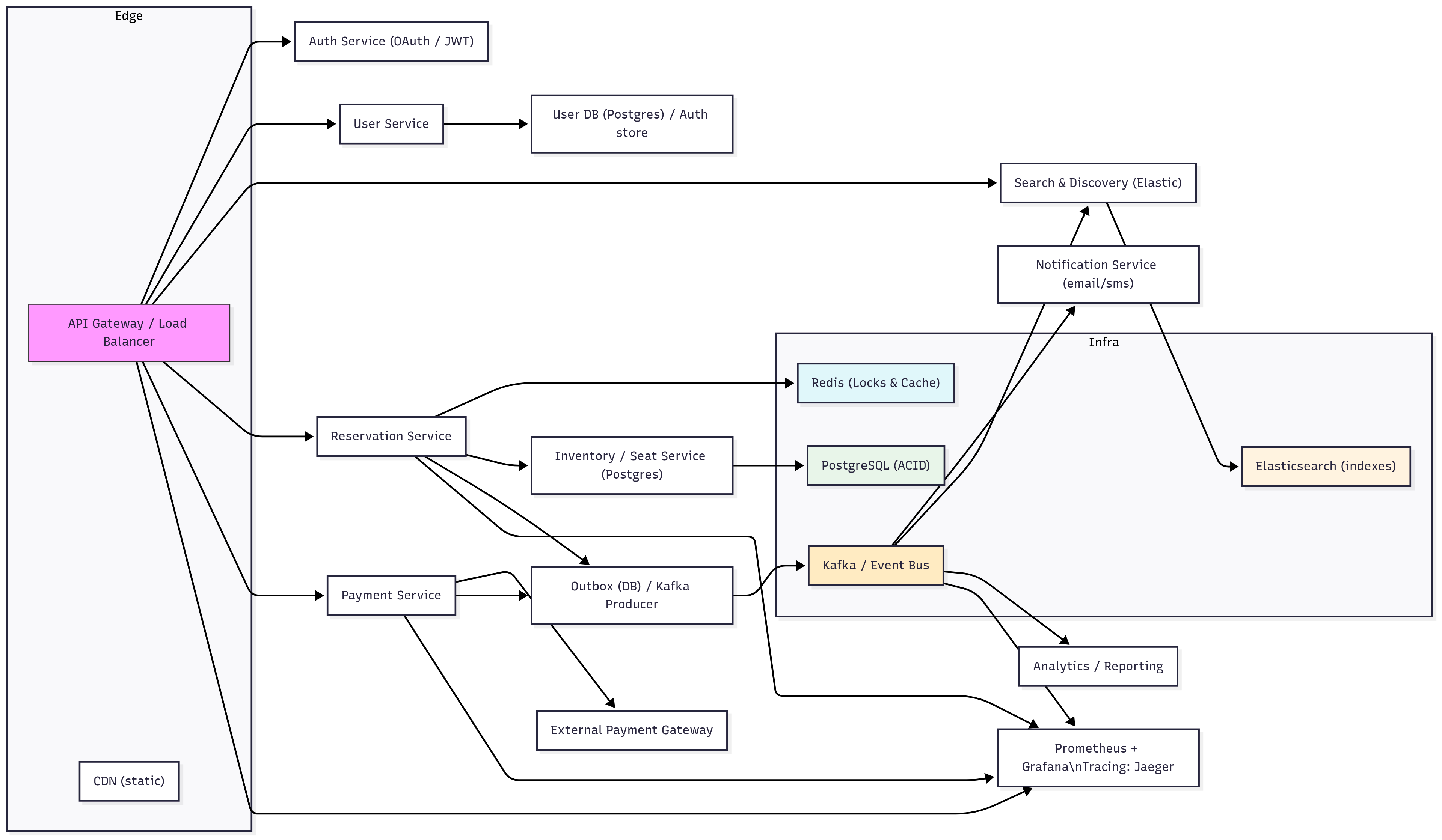
Layered Explanation of the Architecture
Edge Layer
This is where all external traffic first hits.
* CDN (Content Delivery Network)
Delivers static assets (HTML, JS bundles, CSS, images, seat maps).
Protects backend from unnecessary traffic.
Provides caching, DDoS protection, and global distribution.
Example: Cloudflare, Akamai, AWS CloudFront.
* API Gateway / Load Balancer
Routes API requests to microservices.
Handles rate limiting, authentication enforcement, request/response logging.
Provides blue/green or canary deployments (roll out new versions gradually).
Example: Spring Cloud Gateway, Nginx, Kong, AWS ELB.
Purpose: Protects the system, optimizes performance, and manages traffic at scale.
Service Layer
These are Java Spring Boot microservices, each handling one bounded context.
Auth Service (OAuth / JWT)
Issues and validates tokens (JWT, OAuth2).
Integrates with User DB (credentials, roles).
Used by all services for authorization.
User Service
Manages user profiles, preferences, history.
Reads/writes from User DB.
Provides APIs for account management.
Search Service
Queries Elasticsearch for events.
Provides autocomplete, filters (price, location, category).
Reads from Event indexes (kept in sync via Kafka).
Reservation Service
Heart of the system — manages seat selection & reservation lifecycle.
Uses Redis for temporary locks (to avoid double booking).
Persists confirmed reservations in Inventory DB (Postgres).
Uses Outbox Pattern to reliably publish events (e.g., “reservation created”).
Payment Service
Manages payments with external payment providers (Stripe, iyzico, PayU, etc.).
Idempotency keys to avoid double charging.
On success, triggers reservation confirmation and publishes events to Kafka.
Notification Service (Kafka Consumer)
Sends emails/SMS/push notifications.
Example: “Your Coldplay ticket is confirmed!”
Decoupled via Kafka to avoid slowing down reservation/payment flow.
Analytics Service (Kafka Consumer)
Processes events for reporting.
Tracks sales, popular events, failed payments.
Feeds dashboards for admins and marketing.
Purpose: Each service has a single responsibility, can scale independently, and communicates via REST + Kafka events.
Data & Infrastructure Layer
PostgreSQL (ACID Database)
Stores seats, reservations, transactions, user data.
Ensures no double-booking with ACID guarantees.
Use Optimistic
locking
UPDATE reservations
SET seat_number = 'B12', version = version + 1
WHERE reservation_id = 123 AND version = 2;
Redis
Distributed locks (SETNX + TTL) to prevent race conditions.
Cache for hot data (seat maps, popular events).
Elasticsearch
Optimized for search queries.
Stores event metadata for fast text-based discovery.
Kafka (Event Bus)
Asynchronous communication between services.
Decouples Reservation → Notification → Analytics → Search updates.
Supports event replay and resilience.
Purpose: DB = truth, Redis = speed, Elasticsearch = search, Kafka = async glue.
Monitoring & Observability Layer
Prometheus
Collects system metrics (CPU, memory, API response time, DB latency).
Grafana
Visual dashboards for real-time monitoring.
Jaeger (Distributed Tracing)
Tracks requests across microservices.
Example: User → Reservation → Payment → Kafka → Notification.
Purpose: Detect bottlenecks, errors, and ensure uptime during ticket rush.
Summary in Layers
Edge Layer: Protects and routes traffic (CDN + Gateway).
Service Layer: Business logic in microservices (Auth, Reservation, Payment, Search).
Infra Layer: Data stores and async communication (Postgres, Redis, Elastic, Kafka).
Monitoring Layer: Visibility and reliability (Prometheus, Grafana, Jaeger).
Bonus : 1 Million Users
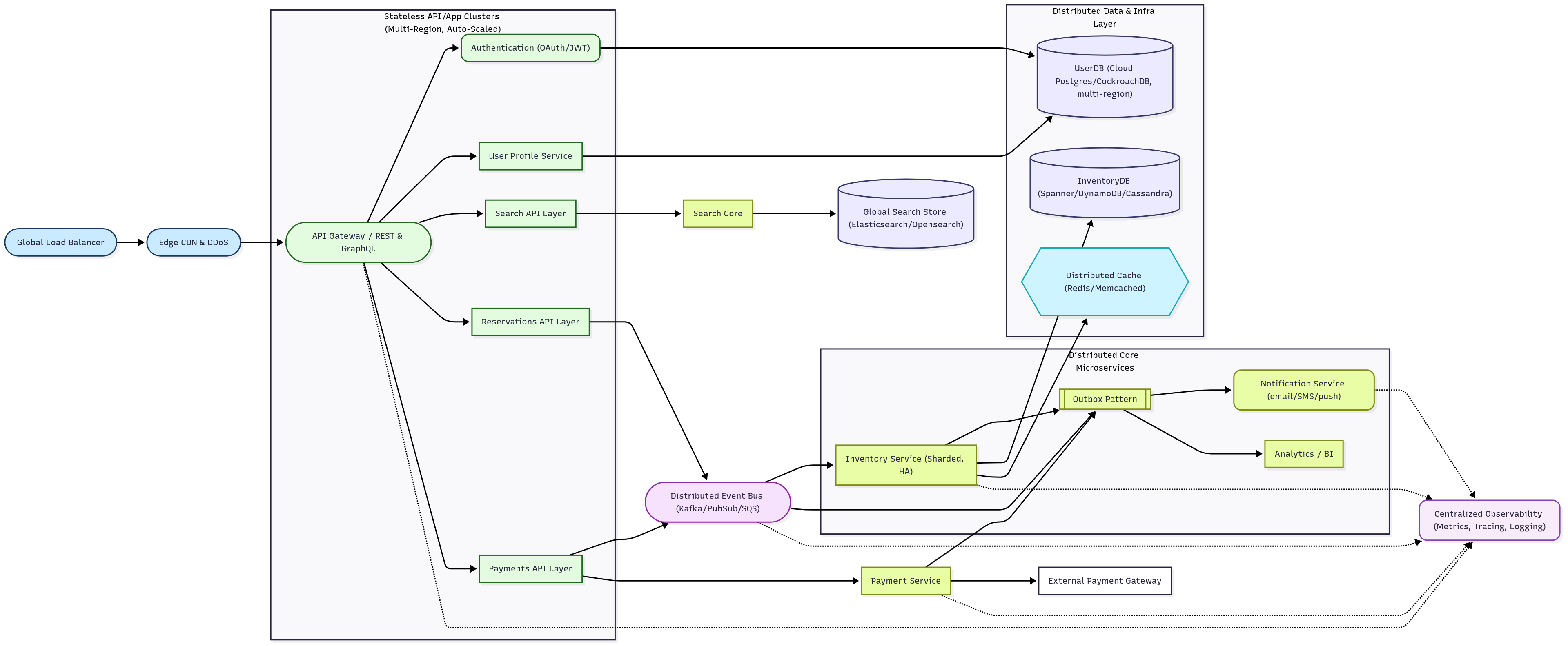
Making a conclusion
👨👦👦 Leave a comment, I am free for discussion with your any kind technical question.