
The Hidden Hero of Modern Media: FFmpeg and the Illusion of Complexity
The Hidden Hero of Modern Media: FFmpeg and the Illusion of Complexity
FFmpeg is the leading multimedia framework, able to decode, encode, transcode, mux, demux, stream, filter and play pretty much anything that humans and machines have created. It supports the most obscure ancient formats up to the cutting edge. No matter if they were designed by some standards committee, the community or a corporation. It is also highly portable: FFmpeg compiles, runs, and passes our testing infrastructure FATE across Linux, Mac OS X, Microsoft Windows, the BSDs, Solaris, etc. under a wide variety of build environments, machine architectures, and configurations.
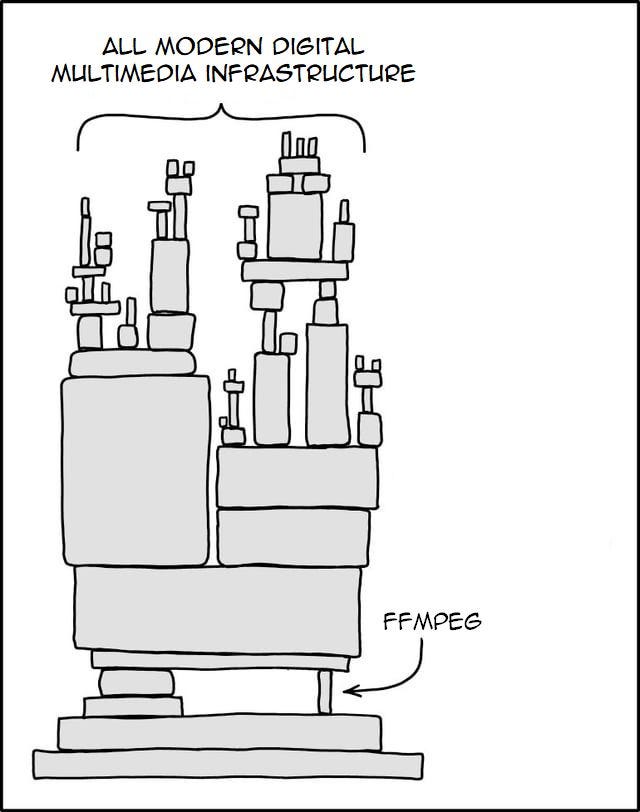
Table of Contents
- Introduction — In Praise of the Unseen
- The Modern Media Stack: A Tower Built on Buzzwords
- The Silent Backbone: What FFmpeg Actually Does
- Why It Still Works: The Engineering Behind FFmpeg’s Longevity
- Microservices, Containers, and the Same Old Binary
- Lessons from FFmpeg: Writing Resilient, Minimalist Tools
- The Value of Simplicity in an Over-Engineered World
- What We Can Learn: Building the Next FFmpeg
- Conclusion — The Command-Line Wizard That Never Quit
- Reading and Resources
- Making a conclusion
Introduction — In Praise of the Unseen
Modern media infrastructure is a house of mirrors. At a glance, it looks like a dazzling, AI-optimized, container-orchestrated labyrinth of microservices — but at its heart lies a simple binary: FFmpeg.
The core idea of this article is not to glorify the past, but to learn from what survived. FFmpeg isn’t flashy, it’s not cloud-native by default, and it doesn’t need 12-factor design. But it works. Everywhere. For everyone. Always.
This is a story about understanding what really powers today’s media pipelines — and why we should strive to write tools like FFmpeg: tools that are focused, fault-tolerant, and enduring.
The Modern Media Stack: A Tower Built on Buzzwords
Talk to any modern media startup and you’ll hear a familiar chorus:
“We use AWS Elemental + Kubernetes + FFmpeg in containers triggered via Lambda behind an API Gateway orchestrated by Argo Workflows…”
It sounds impressive — and some of it truly is. But very often, what’s
really doing the heavy lifting is the same 20-year-old C codebase quietly running somewhere in /usr/bin.
The irony? While the architecture grows more abstract and layered, the media transformation itself is often just:
ffmpeg -i input.mp4 output.mp4
The Silent Backbone: What FFmpeg Actually Does
FFmpeg is a complete, cross-platform solution to record, convert, stream, and process audio and video. It can:
- Transcode media from one format to another
- Segment and mux streams
- Add filters, overlays, subtitles
- Record live input or convert from raw data
- Do all of this… via a single binary
It’s like a Swiss Army knife, but for digital media — and it has no runtime dependencies, no config servers, no queue consumers. Just compile and run.
4. Why It Still Works: The Engineering Behind FFmpeg’s Longevity
So why does FFmpeg still dominate?
- Focused Scope: It does one thing well — media processing
- Stability: It rarely breaks between versions
- Performance: Highly optimized C code with native codec support
- CLI First: No UI, just predictable commands
- Portable: Works on Linux, Windows, Mac, mobile, embedded… anywhere
FFmpeg follows the Unix philosophy to the letter: “Write programs that do one thing and do it well.”
Microservices, Containers, and the Same Old Binary
Here’s a familiar setup in 2025:
- A user uploads a video
- An API Gateway triggers a Lambda
- Lambda puts a message on SQS
- A container listens, pulls the file
- Then runs:
ffmpeg -y -i uploaded.mp4 -c:v libx264 -preset fast output.mp4
All that ceremony… to wrap a single command.
This isn’t a critique of microservices — they bring real value in orchestration, scaling, and security — but it highlights a deeper truth: without solid core tools like FFmpeg, all the orchestration means nothing.
Lessons from FFmpeg: Writing Resilient, Minimalist Tools
What makes FFmpeg a role model?
- CLI-first design
- Stateless by default
- No assumptions about the environment
- Built for scripting, not clicking
- Deep documentation and man pages
We need more tools like this — tools that:
- Don’t require cloud to run
- Can be embedded into larger systems
- Are composable and testable
- Have stable, predictable behavior
It’s not about going “old-school”; it’s about going bulletproof.
The Value of Simplicity in an Over-Engineered World
Modern dev culture sometimes favors complexity over clarity.
- A single page app loads 100MB of JS for a to-do list
- A CI/CD pipeline takes 15 minutes to deploy a static site
- An AI model wraps around a basic regex engine
We forget that most systems break at the edges. The more moving parts, the more chances something fails.
FFmpeg reminds us: less is more, especially when “less” is mature, stable, and thoroughly tested.
What We Can Learn: Building the Next FFmpeg
If you’re a developer, architect, or open source maintainer, here are a few design principles to consider:
Design for CLI: Make tools that are easily
scriptable
Avoid unnecessary
dependencies
Be transparent in failure and
logs
Expose primitives, not magic
abstractions
Document the hell out of
it
Test for edge cases — then test
again
These aren’t rules from the past. They’re rules that still work, if we have the discipline to follow them.
Conclusion — The Command-Line Wizard That Never Quit
FFmpeg is not just a media tool. It’s a living example of what software can be when built with focus, precision, and respect for the craft.
So the next time you ship a shiny new pipeline with CI/CD triggers and streaming nodes, remember: in a container somewhere, a lone FFmpeg process is doing all the work.
And it’s not complaining.
It’s just running.
Reading and Resources
- FFmpeg.org — Official site
- FFmpeg Cheat Sheet
Making a conclusion
👨👦👦 Leave a comment, I am free for discussion with your any kind technical question.
#FFmpeg #MediaTechnology #SoftwareEngineering #CommandLineTools #DeveloperProductivity